MEDA has adopted an effort to promote economic development as a valuable investment for Maryland, its counties, and its municipalities.
Public Policy Awareness
MissionThe primary mission of the committee will be to make MEDA members aware of public policy issues related to jobs and investment at the state and local levels. The committee will also work with elected and appointed officials to increase their understanding of economic development and the impact of public policy on creating and retaining jobs in Maryland. Finally, the Committee will assist MEDA members with training to become more effective in engaging with elected and appointed officials. |
MEDA and The MEDA Foundation, Inc. do not take a position on any bills and do not lobby.
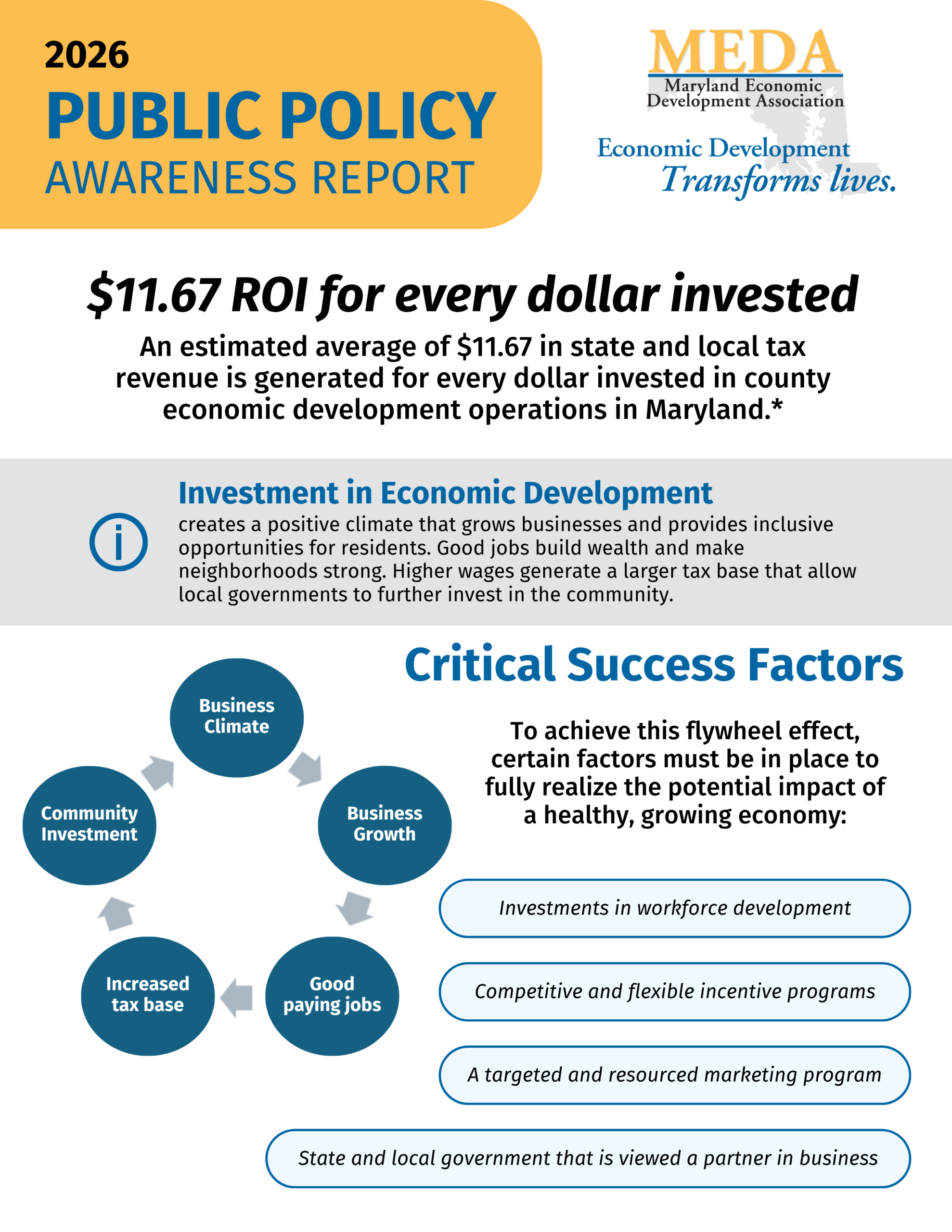
MEDA Announces $11.67 Return On Investment From Every Dollar Invested in Economic Development in Maryland
The Maryland Economic Development Association (MEDA) announced the release of updated impact data from its annual study of county economic development offices in Maryland. According to the findings, every dollar invested in county economic development operations over the past three fiscal years has generated an estimated average of $11.67 in state and local tax revenue.
The study was conducted in collaboration with the Business Economic and Community Outreach Network (BEACON) at Salisbury University and MEDA’s Public Policy Awareness Committee, utilizing IMPLAN, a regional economic analysis software, to model the data. The analysis drew on information reported by economic development offices across Maryland from 2024, 2025, and 2026, focusing on jobs created or retained and the level of county investment in economic development operations.
A special thank you goes to Eastport Partners and Avantis for their help with this project.
 Loading...

 Reload document
  Open in new tab
 Organizations for Legislation

State and General Assembly Related Boards, Commissions, and Committees of Interest
▼Accountability Implementation Board
The Accountability Implementation Board is an independent unit of State government whose purpose is to hold State and local governments, including county boards of education, accountable for implementing the Blueprint for Maryland’s Future and evaluating the outcomes achieved against the goals of the Blueprint for Maryland’s Future and the Commission during the implementation period.
▼Department of Commerce’s Boards and Commissions
The Department of Commerce staffs nineteen boards and commissions that provide recommendations and direction to the Department. These boards focus on targeted groups and industry sectors such as small businesses, federal facilities, tourism, and manufacturing. Links to each of these commissions can be found here.
▼Joint Federal Action Oversight Committee
The Joint Federal Action Oversight Committee has been established by General Assembly leadership to monitor the federal budget and other actions that may affect Maryland’s budget and employment.
▼Board of Revenue Estimates
The Board of Revenue Estimates, in the Office of the Comptroller, is responsible for estimating State revenues. It generally meets in September, December, and March of each fiscal year to review the findings and recommendations of the Revenue Monitoring Consensus Group. The Board consists of three ex officio members – Comptroller, State Treasurer, and Secretary of Budget and Management – and the Director of the Bureau of Revenue Estimates serves as Executive Secretary of the Board.
▼Spending Affordability Committee
The Spending Affordability Committee studies and reviews the status and projections of State revenues and expenditures, and the status and projections of the Maryland economy. Its main purpose is to recommend to the Governor and Legislative Policy Committee a rate of growth that limits State spending to a level that does not exceed the rate of growth of the State’s economy. The Committee also recommends how fiscal goals, debt authorization, State personnel levels, and any surplus should be considered by the General Assembly.
▼Board of Public Works
The Board of Public Works is composed of the Governor, Comptroller of Maryland, and State Treasurer to review, approve, and oversee statutorily mandated projects and programs, including significant State expenditures and general obligation bond issuances. The Board also approves expenditures of State loans and capital improvements, except those allotted for State roads, bridges, and highways.
Media Outlets that Cover Policy Issues
| Maryland Matters | Baltimore Banner |
| Maryland Reporter | MACo Blog Conduit Street |
Sponsors